A Question of Water Supply
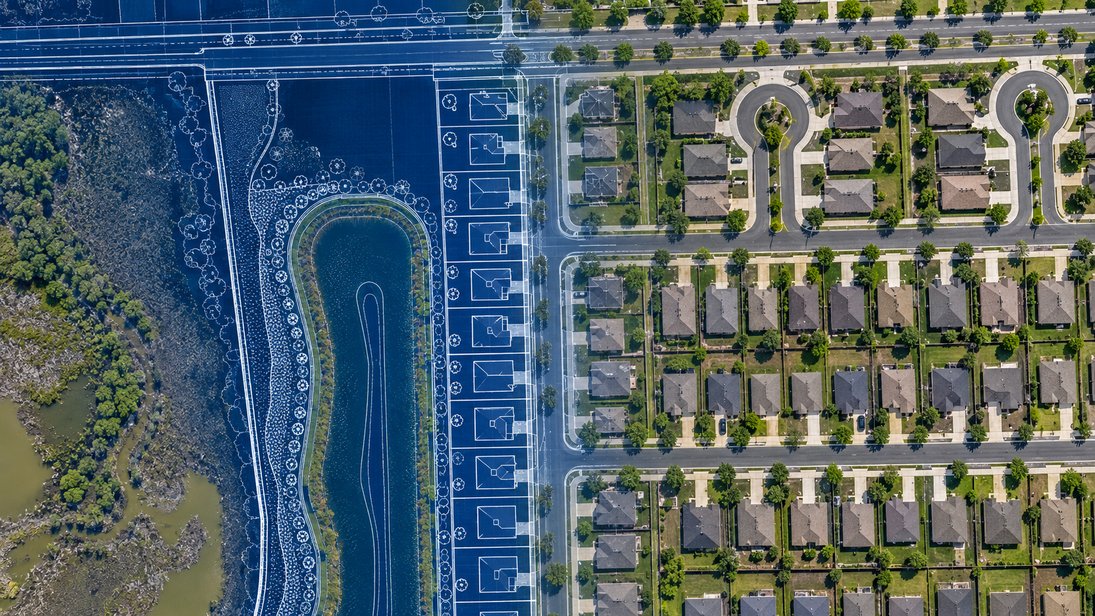
Texas believes that when stormwater falls on your property it is yours to use, until such time it reaches a natural watercourse like a stream or river. That is not true in every state, nor is it true in Canada, the birthplace of hockey, good beer and yours truly. For the record, I am proud to call myself a Texan. My neighbor down in Richmond, TX, takes advantage of falling rain with cisterns, rain barrels, and stock ponds. I do some of this myself, and building upon that principle as a thought exercise, I examined what rainwater harvesting could do for a 200-acre subdivision in the Houston area proposing 800 homes.
Houston averages about 50 inches of rainfall a year, though a drought year can drop that figure to roughly 25 inches. A typical residential development here, not counting the detention facilities themselves, runs about 55 percent impervious. Evaporation averages 54 inches annually. Each home uses around 250 gallons per day. In this layout, 15 percent of the tract (30 acres) would be dedicated to long-term water storage, while another 10 percent (20 acres) would serve as detention storage. After setting those areas aside, the remaining land would support a density of about 5.33 homes per acre. I do this for fun.
In my scenario above, the development’s total water demand comes to 200,000 gallons per day, or roughly 9.8 million cubic feet per year. Fifty inches of rain falling on 200 acres yields about 833 acre-feet, or 36 million cubic feet, of rainfall annually. Applying a conservative 55 percent runoff coefficient, realistic for our heavy clay soils, produces roughly 19.9 million cubic feet of runoff in an average year. Even in a drought year the numbers remain workable: 18.1 million cubic feet of rainfall generates about 9.9 million cubic feet of runoff, still slightly above demand.
Detention ponds in Houston fulfill a variety of important roles that extend well beyond their primary function of flood control. For many residents who may not typically consider stormwater management, these facilities often appear simply as attractive water features, inviting recreational spaces, or valuable wildlife habitats that enhance local parks and greenways. At the same time, outside of managing excess runoff during heavy rains, detention ponds provide a crucial first stage of water-quality treatment: by temporarily holding stormwater, they allow sediments, suspended solids, and floating debris to settle out of the water column, so that cleaner water can then be gradually released downstream or transferred into longer-term storage areas.
Two losses could shrink usable volume: infiltration and evaporation. Proper pond-bottom design can essentially eliminate seepage. Evaporation, however, runs about 54 inches per year and spreading across the 30-acre long-term storage pond, that loss equals roughly 5.9 million cubic feet annually. In an average year the surplus is large enough that the loss is manageable. In a drought year the margin tightens. California has already demonstrated a practical countermeasure: floating shade balls—4-inch plastic spheres partially filled with water—that can cut evaporation by as much as 90 percent. An incidental benefit is that the balls discourage waterfowl from landing, reducing bacterial loading.
Turning stormwater into a reliable domestic supply still requires careful attention to treatment, regulatory acceptance, and long-term operations. It also requires a drainage engineer that understands the difference between what is engineerable and what is economically viable. Just because it can be built doesn’t mean it should be built. If you have additional questions that should be factored into an analysis or a potential project you are considering, contact me and my team and we will be pleased to discuss.
Dr. Culp is the most senior hydrologist at Tetra Land Services and has three decades of civil engineering experience. His Ph.D. scholarship studied the effectiveness of structural BMP for the control of storm water pollution in Harris County while performing water quality monitoring and modeling upon selected ponds for the county. Dr. Culp also co-authored the City of Houston stormwater quality management plan. He is one of Texas’s original Certified Floodplain Managers. Recently, Dr. Culp and his staff have developed a series of drainage studies for Industrial and Oil Majors along the Texas Gulf Coast. Culp is married with two children, and lives on his farm in Southwest Houston.