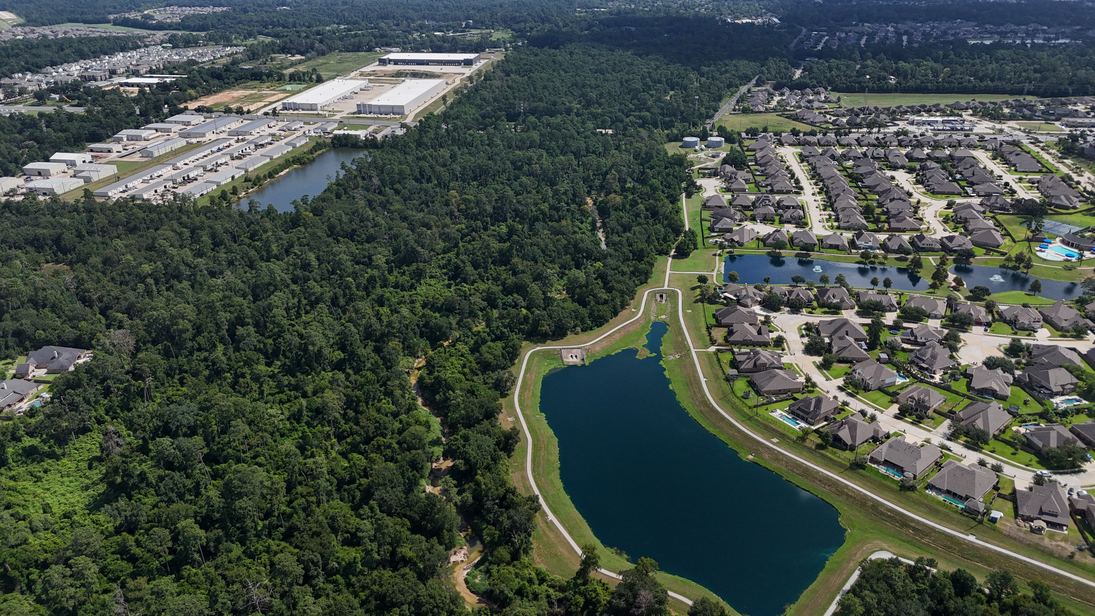
Reflections on Detention Pond
You would think solving a flooding problem is easy. To most people stormwater is a local concern and the obvious answer, bigger is better, seems best. But to a civil engineer, stormwater is far larger than any single-site solution.
Stormwater is a fundamental resource. It replenishes rivers that support transportation, industry, recreation, and habitat for plankton, plants, fish, insects, algae, and birds, while also recharging groundwater. At the same time it is destructive—causing structural damage, erosion, soil contamination, mold, and crop loss. Our job is to combat that destruction without erasing the benefits.
One of the first tools we reach for is the swale, or small ditch. Swales convey flow to a larger sink, offer modest storage, and remain permeable enough for some groundwater recharge. Water moves more slowly than in a storm sewer of the same cross-section because of Manning’s roughness coefficient and gentler longitudinal slopes. Ditches need more right-of-way for stable side slopes against erosion. In rural settings they are almost always the first choice. Once vegetation is established they are relatively easy to maintain. Even with our heavy Gulf Coast clays, most poorly graded ditches infiltrate whatever does not drain within a day or so. Placed on both sides of a street, they keep pavement out of the drainage system for storms well beyond what a conventional curb-and-gutter street can handle.
In high density larger-lot subdivisions for example, raingardens become the logical next step. Public-domain raingardens can link several lots until flows exceed what one facility can manage; a maintenance organization is then usually required. I keep drainage areas under about two acres. Raingardens occupy less footprint than ditches while providing comparable storage and conveyance as the side walls can be nearly vertical. A four-foot-deep, six-foot-wide raingarden yields roughly nine cubic feet of storage per linear foot. Most local soils eventually empty the facility. With a slight slope toward the outfall they function like low-flow ditches. Typical widths are six to ten feet, best placed on both sides of the street and about twice the width of a storm sewer, but half that of open ditches. At three to four feet deep they usually clear nearby water and sanitary lines. Inlet structures allow street drainage. I prefer locating them between sidewalk and roadway, which may shift the sidewalk farther from the curb. Since they drain quickly, plantings must be both hydrophilic and drought-tolerant. Floratam St. Augustine works well where shade is not an issue; many owners choose lower-maintenance natives.
When soils are heavy or drainage areas larger, we combine the raingarden with a perforated storm sewer underneath. These hybrid systems can serve areas up to the capacity of the pipe. ADS offers perforated pipe to sixty inches; I prefer the AASHTO Class II pattern because perforations run all around the circumference. Under pavement we still need concrete transitions and manholes—only concrete is currently permitted in the Houston area—so manholes with inlet tops are practical. Storage and conveyance are both present; otherwise the system behaves like a raingarden.
When space is truly at a premium, conventional storm sewers remain the most efficient conveyance solution, yet they provide essentially no storage. That storage must be supplied elsewhere, usually in concentrated ponds that consume ten to fifteen percent of the developable land. I keep wondering whether Houston-area agencies would ever seriously consider distributed detention ditches and raingardens spread throughout the site, instead of the large regional facilities we now require. Something worth thinking about.
Dr. Culp is the most senior hydrologist at Tetra Land Services and has three decades of civil engineering experience. His Ph.D. scholarship studied the effectiveness of structural BMP for the control of storm water pollution in Harris County while performing water quality monitoring and modeling upon selected ponds for the county. Dr. Culp also co-authored the City of Houston stormwater quality management plan. He is one of Texas’s original Certified Floodplain Managers. Recently, Dr. Culp and his staff have developed a series of drainage studies for Industrial and Oil Majors along the Texas Gulf Coast. Culp is married with two children, and lives on his farm in Southwest Houston.